
The 1950 twenty dollar bills can be valuable depending on the series. Star notes can be worth a lot more than the standard notes. Continue reading to learn more about these bills.
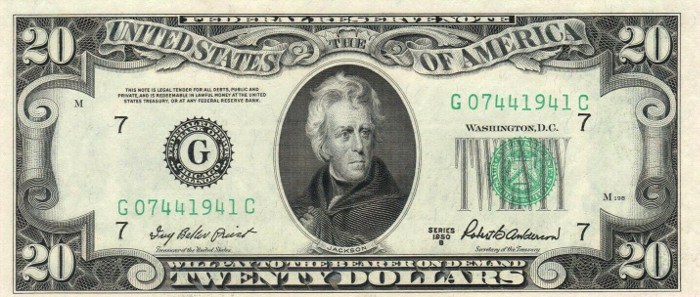
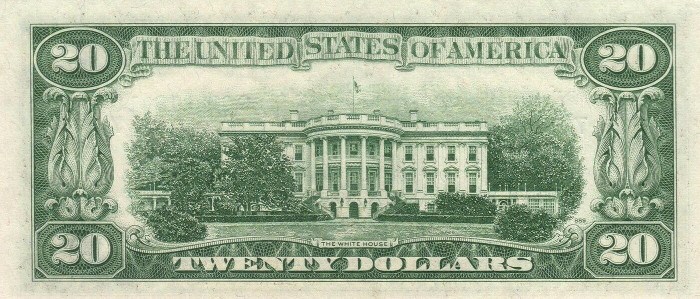
Specifications
| Denomination: | $20.00 USD |
| Type: | Federal Reserve Note |
| Seal Varieties: | One: Green |
| Series: | Six: 1950, 1950A, 1950B, 1950C, 1950D, 1950E |
Value
Most of the 1950 $20 bills are only worth their face value of $20 in circulated condition. In very fine condition the value is around $25. In extremely fine condition the value is around $30-35. In uncirculated condition the price is around $50-75 for bills with an MS 63 grade.
The 1950E series $20 bills are more valuable. Each bill is worth around $50-55 in very fine condition. In extremely fine condition the value is around $60-65. In uncirculated condition the price is around $125-150 for bills with an MS 63 grade.
Star Notes
Star notes are replacement bills that the United States Federal Reserve printed. These star notes are more rare and thus more valuable. You can tell if you have a star note by looking to see if there is a star symbol at the end of the serial number.
Most 1950 series $20 star notes are worth around $75-90 in very fine condition. In extremely fine condition the value is around $125. In uncirculated condition the price is around $300 for notes with an MS 63 grade. Star notes issued from the Federal Reserve Banks of Atlanta and Minneapolis will sell for more money.
Most 1950A series $20 star notes are worth around $80 in very fine condition. In extremely fine condition the value is around $115. In uncirculated condition the price is around $175-200 for notes with an MS 63 grade.
Most 1950B series $20 star notes are worth around $70-80 in very fine condition. In extremely fine condition the value is around $100. In uncirculated condition the price is around $200-300 for notes with an MS 63 grade. Star notes issued from the Federal Reserve Banks of Boston and Richmond will sell for more money.
Most 1950C series $20 star notes are worth around $55 in very fine condition. In extremely fine condition the value is around $110. In uncirculated condition the price is around $200 for notes with an MS 63 grade. Star notes issued from the Federal Reserve Bank of Dallas can sell for more money.
Most 1950D series $20 star notes are worth around $55-60 in very fine condition. In extremely fine condition the value is around $100-125. In uncirculated condition the price is around $200-225 for notes with an MS 63 grade. Star notes issued from the Federal Reserve Bank of Minneapolis will sell for more money.
Most 1950E series $20 star notes are worth around $200 in very fine condition. In extremely fine condition the value is around $350. In uncirculated condition the price is around $750 for notes with an MS 63 grade. Star notes issued from the Federal Reserve Bank of Chicago will sell for more money.
Note: Valuable bills should be placed inside currency holders.
Grading System
Very fine- A note that has been in circulation but not for a long time. The note is still relatively crisp. There may be some creases, folds, or light smudges.
Extremely fine- A note that shows small signs of having been in circulation. The note will be bright and it will have almost all of its original crispness. There might be one or two minor creases or folds but there are no stains, discolorations, or tears.
MS 63 choice uncirculated- A note that shows no signs of ever having been in circulation. The note still has its original crispness. The note is also well-centered.
Sources:
A Guide Book of United States Paper Money
See also: